

LOAN BASICS
VA, FHA, or Conventional: Which Loan Fits You?
Three loans, three very different sets of rules. See how they compare on down payment, credit, and monthly cost, then talk with a VA Mortgage Specialist who will show you real numbers for your situation.
No pressure and no obligation. Just straight answers from people who understand military service.
QUICK COMPARISON
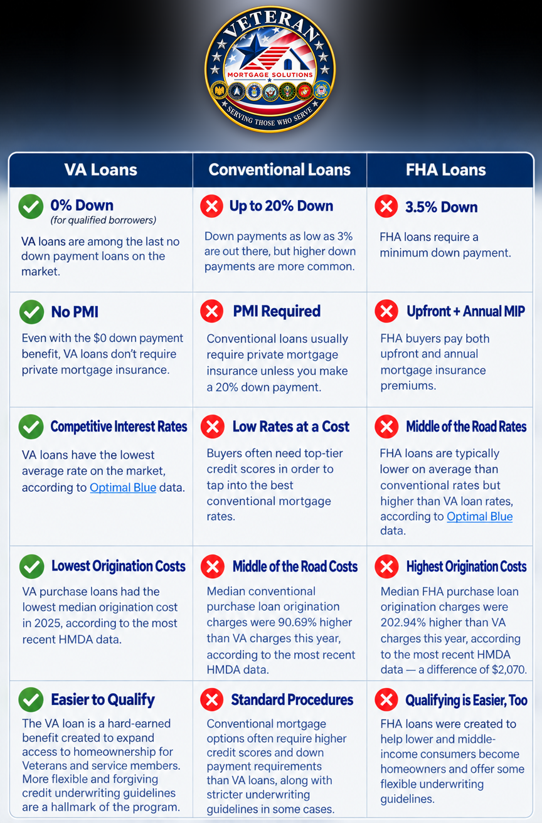
VA vs. FHA vs. Conventional at a Glance
Use this side-by-side view to understand the major differences, then compare your actual monthly payment and total cost with a specialist.
| FEATURE | VA LOAN | FHA LOAN | CONVENTIONAL LOAN |
|---|---|---|---|
| Who it's for | Eligible Veterans, service members, and some surviving spouses | Buyers with smaller savings or lower credit scores | Buyers with solid credit and steady income |
| Minimum down payment | 0% in most cases | 3.5% with a 580+ credit score | As low as 3% |
| Credit score | No VA minimum; lenders set their own | 580+ for 3.5% down; 500-579 requires 10% down. Many lenders require 620 | Typically 620 or higher |
| Monthly mortgage insurance | None | Yes, typically about 0.55% of the loan per year | Private mortgage insurance (PMI) if less than 20% down |
| Upfront cost | VA funding fee (many Veterans are exempt) | 1.75% upfront mortgage insurance premium | No upfront insurance premium in most cases |
| Loan limits (2026) | No VA-set cap for Veterans with full entitlement | $541,287 in most counties, up to $1,249,125 in high-cost areas | $832,750 in most counties, up to $1,249,125 in high-cost areas |
| Property use | Primary residence | Primary residence | Primary, second home, or investment property |
| Can mortgage insurance be removed? | Not applicable | Only after 11 years, and only with 10%+ down. Otherwise it lasts the life of the loan | Yes, PMI can be removed once you reach 20% equity |
Figures are general guidelines. Your lender's requirements and your county's limits may differ.
No pressure. No obligation.
UNDERSTAND YOUR OPTIONS
Three Loan Types, Three Different Paths
VA Loans: The Benefit You Earned
A VA loan is a mortgage backed by the U.S. Department of Veterans Affairs and available to eligible Veterans, active-duty service members, National Guard and Reserve members, and certain surviving spouses. For many who qualify, it's the most affordable way to buy or refinance a home.
No down payment required in most cases
No monthly mortgage insurance, which can save you hundreds of dollars every month
No VA minimum credit score, so more borrowers can qualify
Competitive rates thanks to the VA guarantee
Flexible refinance options, including the VA Interest Rate Reduction Refinance Loan (IRRRL), a streamlined option to lower your rate
WHAT TO KNOW
Most borrowers pay a one-time VA funding fee. For a first-time VA loan with less than 5% down, it's 2.15% of the loan amount. It drops to 1.5% with 5% down and 1.25% with 10% down. Repeat use with less than 5% down is 3.3%. You can roll the fee into your loan or pay it at closing. Many Veterans pay no funding fee at all, including those receiving VA disability compensation and eligible surviving spouses receiving DIC. The home must be your primary residence and meet VA property standards.
BEST FOR
Eligible Veterans and service members who want low upfront costs and no monthly mortgage insurance.
FHA Loans: Flexible Qualifying With a Small Down Payment
An FHA loan is insured by the Federal Housing Administration. It's designed to help buyers with limited savings or lower credit scores. Anyone can apply, not only Veterans.
Down payments as low as 3.5% with a credit score of 580 or higher
More flexible credit guidelines than many conventional loans
Gift funds can generally be used toward your down payment
Streamline refinance options for existing FHA borrowers
WHAT TO KNOW
FHA loans require mortgage insurance: an upfront premium of 1.75% of the loan amount, plus an annual premium (typically around 0.55%) paid monthly. With less than 10% down, mortgage insurance generally lasts for the life of the loan. With 10% or more down, it drops off after 11 years. The home must be your primary residence and pass an FHA appraisal. Many lenders set stricter credit minimums than FHA itself.
BEST FOR
Buyers who aren't VA-eligible and have limited savings or a lower credit score, or borrowers who want to compare an alternative to a VA loan.
Conventional Loans: Flexibility for Strong Credit
A conventional loan isn't backed by a government agency. It follows guidelines set by Fannie Mae and Freddie Mac and is funded by private lenders. It's the most common type of mortgage in the U.S.
Down payments as low as 3% for qualified buyers
Cancelable mortgage insurance. Once you reach 20% equity, you can request that PMI be removed.
Broad flexibility on loan terms (15, 20, or 30 years) and property types, including second homes and investment properties
Higher loan limits than FHA in most counties
WHAT TO KNOW
With less than 20% down, you'll pay private mortgage insurance (PMI). Your cost depends on your credit score and down payment. Most lenders look for a credit score of 620 or higher. Higher scores earn better rates. Loans above the conforming limit ($832,750 in most counties) are 'jumbo' loans with stricter requirements.
BEST FOR
Buyers with strong credit and a larger down payment, or those buying a second home or investment property.
HOW TO CHOOSE
Which Loan Is Right for You?
The right loan depends on your service history, savings, credit, and goals. Here's a simple way to start:
1
Served in the military?
Start with a VA loan. For most eligible borrowers, it offers the lowest upfront costs and no monthly mortgage insurance.
2
Have 20% or more to put down?
A conventional loan can be competitive, since you'd avoid PMI. A specialist can compare it to your VA options.
3
Smaller down payment / lower credit?
Not VA-eligible, with a smaller down payment or lower credit score? An FHA loan may open the door.
4
Second home or investment property?
VA and FHA loans require you to live in the home, so conventional is typically the path.
A VA loan isn't always the answer, and we'll tell you if it isn't. We'll run the numbers side by side so you can see the true monthly payment and total cost of each option.
BEYOND THE BASICS
What Every Loan Has in Common
No matter which loan you choose, lenders review the same core factors:
Credit history and score
Your record of borrowing and repayment helps lenders evaluate risk.
Income and employment stability
Lenders look at whether your income can support the monthly payment.
Debt-to-income ratio
Your monthly debts are compared to your income.
The property
The home must be appraised and meet the loan program's standards.
Improving any of these can lower your rate and expand your options. A specialist can show you where you stand and what to focus on.
QUICK FIT CHECK
Which Loan Fits Me?
A quick conversation about three things can narrow your options fast.
Question 1
Military service history
Are you an eligible Veteran, service member, National Guard or Reserve member, or surviving spouse?
Question 2
Down payment
How much do you expect to put down, 0%, 3% to 5%, 10%, or 20%+?
Question 3
Credit range
What range best describes your current credit profile?
FREQUENTLY ASKED QUESTIONS
VA, FHA and Conventional Loan FAQs
What is the difference between a VA loan and a conventional loan?
A VA loan is backed by the Department of Veterans Affairs and available only to eligible Veterans, service members, and some surviving spouses. It typically requires no down payment and no monthly mortgage insurance. A conventional loan isn't government-backed, is open to any qualified buyer, and usually requires PMI if you put down less than 20%.
Is a VA loan better than an FHA loan?
For eligible borrowers, a VA loan is often more affordable because it typically requires no down payment and no monthly mortgage insurance, while FHA loans require both upfront and annual mortgage insurance. The best choice still depends on your situation, so it's worth comparing real numbers.
How much do I need to put down on each type of loan?
VA loans typically require no down payment. FHA loans require as little as 3.5% with a 580+ credit score. Conventional loans start as low as 3% for qualified buyers.
What is the VA funding fee?
It's a one-time fee that helps keep the VA loan program running. For a first-time VA purchase with less than 5% down, it's 2.15% of the loan amount. The fee is lower with a larger down payment and higher for repeat use. Veterans receiving VA disability compensation and certain surviving spouses are exempt.
Do FHA loans have mortgage insurance?
Yes. FHA loans include an upfront premium of 1.75% plus an annual premium, typically paid monthly. With less than 10% down, it generally lasts for the life of the loan.
Can I get rid of PMI on a conventional loan?
Yes. You can generally request PMI removal once you reach 20% equity in your home, and it's automatically terminated at a later equity threshold under federal law.
Can I use a VA loan for an investment property?
No. VA loans are for a home you'll occupy as your primary residence. You may be able to buy a multi-unit property (up to four units) if you live in one of the units.
What credit score do I need?
The VA doesn't set a minimum, but most lenders do. FHA allows scores as low as 500 with 10% down (580+ for 3.5% down), and conventional loans typically require 620 or higher. Lender requirements vary.
Not Sure Which Loan Is Best? Let's Figure It Out Together.
You served. You shouldn't have to decode mortgage jargon on your own. A Veteran Mortgage Solutions VA Mortgage Specialist will compare your options, explain the costs in plain English, and help you choose with confidence.
Ready to Explore Your VA Loan Options?
Whether you are buying, refinancing or simply trying to understand what your VA benefit may allow you to do, you do not have to figure it out alone.
Talk with a Veteran Mortgage Solutions loan specialist and get clear answers about your options.
Serving Veterans and military families from coast to coast, where licensed.